
Children flourish when they are safe, secure, loved, and given the freedom to explore their world in ways that reflect their abilities. At the same time, children are vulnerable; they are naturally dependent on others around them. Having type 1 or type 2 diabetes makes childhood challenging in ways that children and youth without diabetes do not experience.
Childhood is a time of constant transitions—physical, intellectual, emotional, social and psychological. It’s also a time of development, when the foundational building blocks for life are laid. As parents, we strive to create the optimal conditions to support our children’s development. However, when we send them to school, they enter a critical stage of development where parents can’t control the environment. Teachers play a significant role in this development, and our children begin to form patterns of friendships with classmates. How will our children with type 1 or type 2 diabetes be treated? Will their diabetes be accepted and normalized, or rejected and mocked? This is where diabetes stigma in the school setting becomes a critical concern.
Schooling is critical to development but where does diabetes fit into the school culture? This question may keep parents awake at night throughout their child’s development.
Why is stigma an issue?
Diabetes is not a disease that can be managed in private. It shows up every day, around the clock. A recent US study surveyed diabetes educators who estimated that those with type 2 diabetes could spend 66 to 234 minutes per day on diabetes self-management tasks. For those with type 1 diabetes, that time jumped to as much as 78 to 305 minutes/day. The point here is that youth with diabetes need to bring their diabetes to school! How children with diabetes are treated by their peers and teachers can have a huge influence on how they adapt to and manage their disease. And while technology advances have enabled the development of devices to automate diabetes management, these tools are often visible to others; insulin pumps and continuous glucose monitors separate those with diabetes from those without. Visible signs of being different from children without diabetes may evoke misunderstanding and judgements from others. Consider the image below.
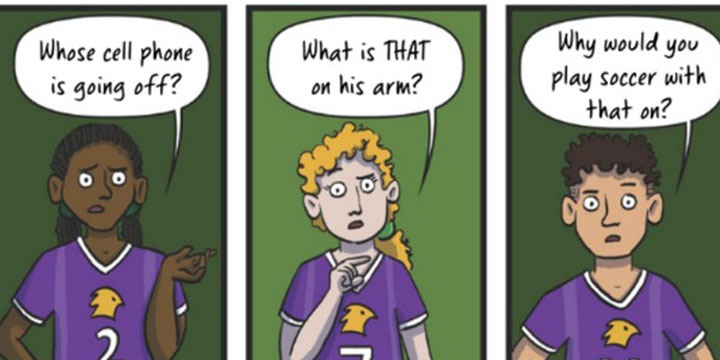
Reactions youth often hear from peers when they see their diabetes tech, from The Sideline Secret, a children’s graphic novel exploring T1D stigma youth experience at school.
What is the issue?
Within diabetes, we are beginning to appreciate the social aspects of diabetes management. Typically, diabetes management has been seen as a personal and family issue, which of course it is. However, how you are treated by others has an enormous impact on diabetes acceptance and self-management. Unfortunately, the experience for most children with type 1 or type 2 diabetes in the school setting is to experience bias and stigma due to their disease.
Stigma in the school environment is associated with poorer psychosocial functioning, increased depressive symptoms, reduced self-care, and poorer glycemic control in both type 1 diabetes (T1D) and type 2 diabetes (T2D) youth. To avoid attention, students often conceal their condition, which can jeopardize their health. Stigma also leads to absenteeism, social isolation and hindered academic achievement due to both direct discrimination and the emotional burden of managing a chronic illness in a stigmatizing environment.
“After being diagnosed with T1D my siblings right away told all our friends… they all said that I was contagious and ran away screaming. From then on they stayed at least 6 feet away from me and would always make comments… I eventually stopped trying to play and hangout and spent most of my time alone.” ~ Iman, Grade 12 Student living with T1D (Quoted in Type 1 Diabetes Awareness in Schools – Diabetes Hope Foundation)
Are stigmatizing experiences really that common in the school setting?
Stigma is routed in the biases we hold about others. These biases fuel negative assumptions about people, which in turn can lead to discrimination and social rejection. In case you thought this was a rare occurrence, research suggests that upward of 60 to 80% of children with T1D experience stigma in the school setting. The rates of school-based stigma experienced by children with T2D are not well known yet, although we do know that stigma associated with obesity is very common.
“People have questioned whether I should pursue certain academic opportunities, play sports, or even move out for university, assuming I am incapable of managing on my own because I need support for my diabetes. This is completely untrue – my abilities are not defined by my condition.” ~ Sameeksha, Grade 12 Student living with T1D (Quoted in Type 1 Diabetes Awareness in Schools – Diabetes Hope Foundation)
Humans are social by nature; we need each other and function best in groups. As a result, belonging is critical to both psychological and physical development. Social rejection is a major stress for us all. So, a child facing the choice of attending to their diabetes and being mocked by peers, or ignoring their diabetes in order to fit in, will most often choose social acceptance. This is a critical point because diabetes outcomes depend on self-management which often occurs in a social environment. It is high time to call this out. How can schools be agents of change for the acceptance of diabetes?

Why is this a particular issue for children in the school setting?
Children and adolescents with T1D or T2D face significant psychosocial and health-related challenges. Peer bullying and social exclusion are common, often targeting diabetes technology and resulting in missed social experiences and reduced participation in school activities. Institutional barriers, such as restrictive policies and lack of trained personnel, further compromise inclusion and academic engagement of children with diabetes. This contributes to mental health concerns—including anxiety, depression and low self-esteem—and negatively impacts diabetes self-management, leading to poorer glycemic control and increased risk of diabetes-related complications.
Disease acceptance is the psychological process of making sense of your disease. It’s about finding ways of living with disease that do not reduce quality of life. No one wants to have type 1 or type 2 diabetes and yet to best manage it, you have to be active and engaged in self-management. This makes diabetes a social issue. For students, the attitudes of classmates, teachers or professors toward their disease play a critical role in how well they accept it.
“When I was in kindergarten, one of my friends walked around the entire classroom handing out invitations to their birthday party. They invited every single person except for me. I went home crying… My mom later contacted the parents of my friend and discovered they didn’t invite me because of my diabetes – they were afraid being around that much sugar would not be safe for me. ”
~ Janica, Grade 12 Student living with T1D (Quoted in Type 1 Diabetes Awareness in Schools – Diabetes Hope Foundation)
But how bad can it really be as children are resilient?
Childhood is a critical period for the development of self-esteem. This is why children are particularly vulnerable, and why experiences of stigma are anything but insignificant. While many personal attributes have strong genetic roots (e.g., being an introvert/extrovert or optimist/pessimist), the specific beliefs people develop about themselves are based on their experiences. Child development is clearly a case of nature and nurture.
If we think of self-esteem as the development of specific beliefs about oneself (are you a good person or a bad person, do people like you or dislike you, are you capable or incapable?), it is not surprising that as children develop they internalize the attitudes of others—especially those of important people in their lives—expressed toward them. When it comes to the development of self-esteem, the expression “if you tell a lie enough times people will believe it as truth” carries a lot of merit. Aside from parents and family, many of the important connections children make are in the school setting.
Clearly, teachers have a powerful effect on child development. At the same time, we are hearing of school boards considering banning cellphones in classrooms. While there are reasons why this might improve the learning experience—by reducing distraction and helping keep students more focused—it puts those on an insulin pump or CGM using their phones to monitor and manage their disease at a great disadvantage. Imagine the child with diabetes who obtains “special permission” to bring their phone into class. This might well be an invitation for rejection by classmates who feel deprived of their own device (e.g., “what makes YOU so special?”).
Children are vulnerable to the level of awareness of teachers and school staff about diabetes and its management. Perhaps your child is lucky and has a teacher who also lives with T1D or T2D. But this cannot be controlled and may not be as common as parents would like. Parents would not want to leave this to chance.
“My science teacher offered anyone who could make a salt crystal over the winter break a chocolate bar as a reward. I was the only student to take the offer seriously, yet she refused to give me the promised reward and gave me a sticker instead. I felt angry and frustrated at her lack of understanding, as I was being treated differently than my classmates without it being warranted.” ~ Sophie, Grade 12 Student living with T1D (Quoted in Type 1 Diabetes Awareness in Schools – Diabetes Hope Foundation)
As children develop, their sense of self becomes more and more connected to their peers. Fitting in becomes a strong psychological need for the child. If managing diabetes in front of peers calls negative attention to a child, the need to fit in can easily become more important than the need to manage diabetes.
What can be done about stigma in schools?
The problem with diabetes stigma is that those who experience its effects are not the ones causing the harm. This is where a community perspective is essential—where responsibility is shared and where, as the saying goes, it takes a village to raise a child. I recently published a paper with colleagues from Diabetes Canada on the stigma experiences of adults with type 1 and type 2 diabetes in Canada. One of our conclusions was that “diabetes is a team sport.” It is time we normalize the diabetes experience in schools and provide education and support to those without diabetes so children living with this chronic disease can thrive.
Lack of diabetes knowledge among school staff, insufficient resources (i.e., school nurses), and inadequate support systems exacerbate stigma and its effects.
There are several steps needed to make schools more accepting of students with diabetes. First, schools should have workshops with healthcare professionals and young people who have diabetes. These workshops should focus on “healthy living” without making any student feel different. In turn, diabetes education should be part of regular health classes, and fun learning tools (such as educational plays and stories) can help dispel diabetes myths and prevent bullying. It is especially important to educate about the differences between type 1 and type 2 diabetes, as the rates of type 2 diabetes in children are increasing. Schools should provide private spaces where students can manage their diabetes and ensure that any discussion of a student’s condition is handled respectfully. Establishing healthy eating policies for the entire school, along with training teachers to use sensitive, respectful language when speaking to children with T1D or T2D, can help create a more welcoming and supportive environment. Parents and educators might be interested in online support websites such as diabetes@school.
This article has been sponsored by the Diabetes Hope Foundation, a partner who shares our mission of providing trusted health education.